

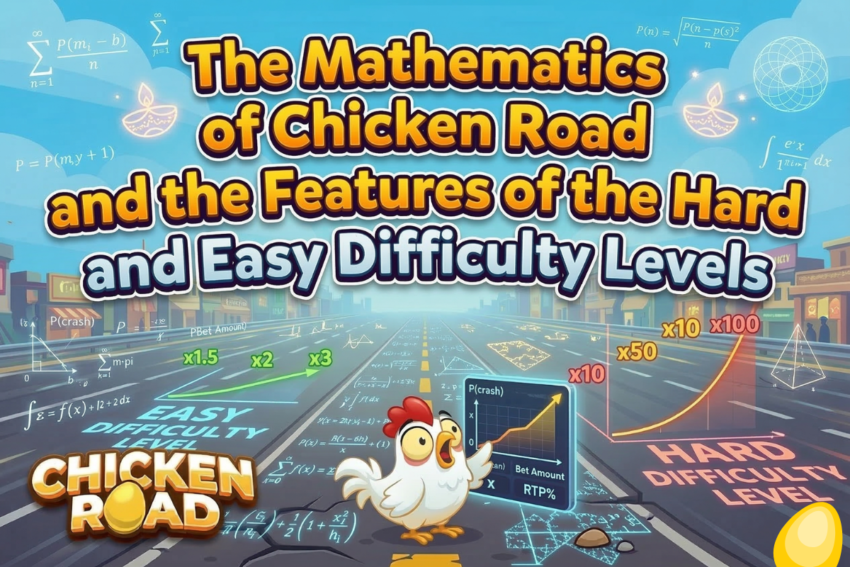
Imagine that you have twenty-five covered dishes from the best restaurant in Delhi in front of you, and most of them contain fragrant chicken, but some contain only gnawed bones. Will you choose with your heart or your head? In the Chicken Road online game, this choice seems random, but in fact, behind every tap on the screen lies strict, cold and uncompromising mathematics. There is no room for pure luck here, only probability theory, which works either for you or against your wallet.
The Illusion of Safety on the Easy Level
Easy mode, or the “easy” difficulty level, means that a minimum number of traps are hidden on the 25-cell field — say, from 1 to 3 bones. It seems that it is almost impossible to lose here, because the field is literally littered with winning chickens.
Indeed, if we take the situation with one trap, your chance of success on the first move is an impressive 96% (24 safe cells out of 25 possible). This feeling of security is relaxing, making you forget that the casino never plays at a loss.
However, the problem with the easy level lies not in the probability of losing, but in the risk-reward ratio. The payout ratio on the first step is so low (usually around 1.03x or slightly more) that you need to make dozens of successful bets in a row to earn a significant amount. But here’s the catch: with each subsequent step you take without taking your money out, the probability of success, while still high, decreases inexorably, and the price of a mistake increases many times over.
The Harsh Reality of the Difficult Mode
Hard mode is when the number of bones (traps) on the field exceeds the number of safe cells. Let’s say you’ve chosen a scenario where there are 20 bones and only 5 chickens hidden on the field. Here, the math works according to completely different rules.
In such a scenario, the probability of guessing a safe cell on the first try is only 20% (5 out of 25). This means that on average, four out of five of your bets will go to the establishment’s income. Seems crazy? Not really, because this is where the giant multiplier comes into play. If you’re collecting crumbs at the easy level, here one lucky click can multiply your bet many times over.
The mathematical model of Hard mode is based on high dispersion: you will lose often, but the rare wins should (in theory) cover these costs.
If we look at the raw numbers of the probability of passing several stages in such a tough mode, the picture is as follows:
- First step: 20% success (1 in 5 chance).
- Second step: approximately 3.3% success (1 in 30 chance).
- Third step: less than 0.5% success (1 in 200 chance).
Comparison of Strategies
The Easy level in Chicken Road game offers the psychological comfort of frequent wins. You see green lights, hear pleasant sounds, and your balance gradually increases. But mathematically, it’s like walking on a razor’s edge: you accumulate risk.
On the other hand, the difficult level (Hard) requires nerves of steel and a large bankroll. You must be prepared to see losses 10, 20, 30 times in a row. Mathematics here favours those who know how to wait. If on the easy level you are fighting to preserve what you have accumulated, then on the difficult level you are hunting for the jackpot. These are fundamentally different mathematical models: accumulation versus hunting.
To clearly see this difference, let’s look at how your position in the game changes depending on the path you choose and the number of steps you plan to take:
- Turtle Strategy (Easy, 1 die). High probability of passing (96%), but to double your bet, you need to take about 20 steps, which reduces the overall probability of success to ~45%.
- Tiger Strategy (Hard, 20 dice). Low probability of the first step (20%), but instant multiplication of the bet several times, which allows you to cover the previous 4 losses with one win.
- The “Balance” strategy (Medium, 5 dice). A happy medium, where the probability of the first step is 80%, but the odds grow faster, allowing you to take your winnings as early as the 3rd or 4th step with a noticeable profit.
When is It Better to Stop?
The most important question in Chicken Road is not “where to click?” but “when to collect your money?” Mathematically, the optimal exit point depends on the selected difficulty, but it almost always comes earlier than our greed tells us. At the easy level, each subsequent step brings a negligible increase to the amount, but adds a full risk of losing the entire bank.
From a probability theory perspective, taking an extra step for a 1.05x multiplier when you already have a large amount at stake is an irrational action with a negative mathematical expectation.
At the difficult level, the situation is reversed. Since the initial bet is usually small (after all, we expect frequent losses), risking it for the sake of the next doubling seems mathematically justified. However, the law of diminishing utility also applies here. The probability of guessing three times in a row at the Hard level tends towards statistical error.
In the context of the Indian market, where players often rely on “lucky days” or intuition, it is important to remember that numbers know no mercy. Each open dish is a separate mathematical equation. The longer you stay in a round of Chicken Road casino, the more statistics weigh on you. The ability to press the “Cashout” button is the only variable in this equation that you control 100%.